Reading room
Netflix uses a specialized language model to rank recommendations more efficiently
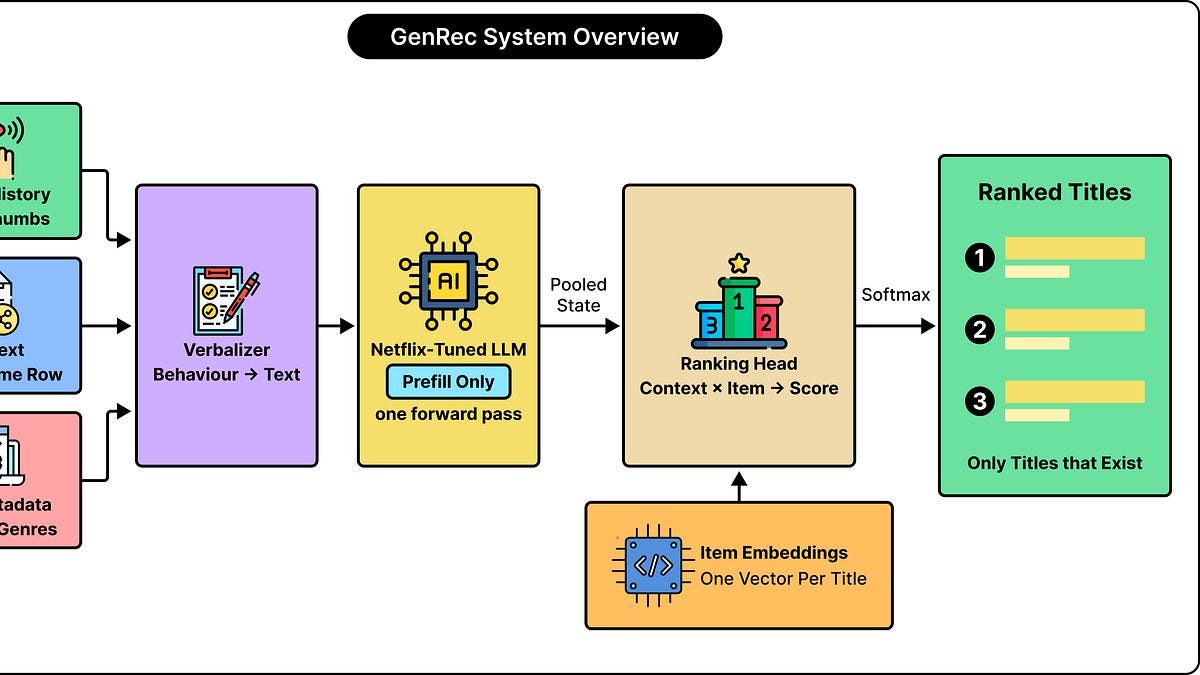
Netflix’s GenRec adapts a language model to understand viewing histories and rank titles from the company’s catalog. The system combines domain training, behavior-derived examples, selective context construction and a ranking head that scores known items rather than generating arbitrary recommendations. Netflix reports modest gains in a four-week test, alongside lower serving costs after compressing context. The account is a secondary synthesis of public material, so its performance figures should be read as reported results, not independent validation.
Editorial summary · Publisher article
What matters
- GenRec uses two training phases: a Netflix-aware foundation stage and recommendation-specific post-training.
- Context engineering removes weak or repetitive signals and reportedly cuts token use to about one-third.
- Prefill-only inference scores catalog items without generating recommendations token by token.
- A test covering about 10% of traffic reported statistically significant but small engagement improvements.
Context & caveats
- The article summarizes publicly shared Netflix material and does not independently verify the reported experiment.
Why this made the edition
The article provides a detailed technical synthesis of Netflix’s GenRec approach, including training, context selection, serving architecture and reported evaluation results.
Source material