AI
Salesforce is moving agent reliability out of the prompt and into system design
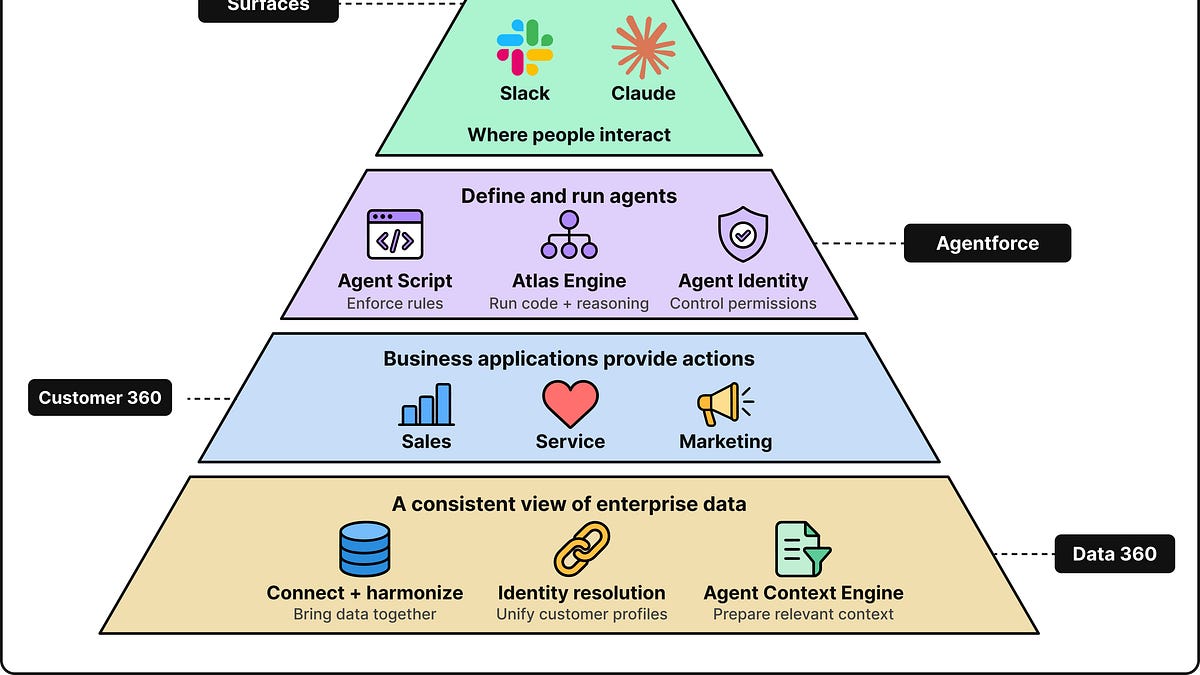
Salesforce’s Agentforce redesign treats reliable enterprise agents as a systems problem rather than a prompting problem. The company separates deterministic rules, identity resolution, context selection and permissions into dedicated layers, leaving the model to handle tasks that require reasoning. The analysis describes Agent Script, Data 360, the Agent Context Engine and Agent Identity, along with a headless interface for Slack and Claude. The architecture is explained largely through Salesforce demonstrations and executive interviews, so production claims warrant independent validation.
Editorial summary · Publisher article
Reliability through separation
The design compiles rules into an executable graph, fetches and reconciles records outside the prompt, selects relevant context, and checks both user and agent permissions before an operation runs.
Lower context and tool overhead
Salesforce reports that managed context reduced one insurance query from 124,000 tokens to 9,000, while tool discovery lets an agent search a small index instead of loading hundreds of tool definitions.
Context & caveats
- The article relies heavily on Salesforce demonstrations and statements from its executives; reported performance is not an independent evaluation.
Why this made the edition
Detailed technical analysis explains how Salesforce separates deterministic controls, data resolution, context selection and permissions from model reasoning, with concrete examples and disclosed executive attribution.
Source material