AI
Programmable agent interfaces shift software design toward managing human attention
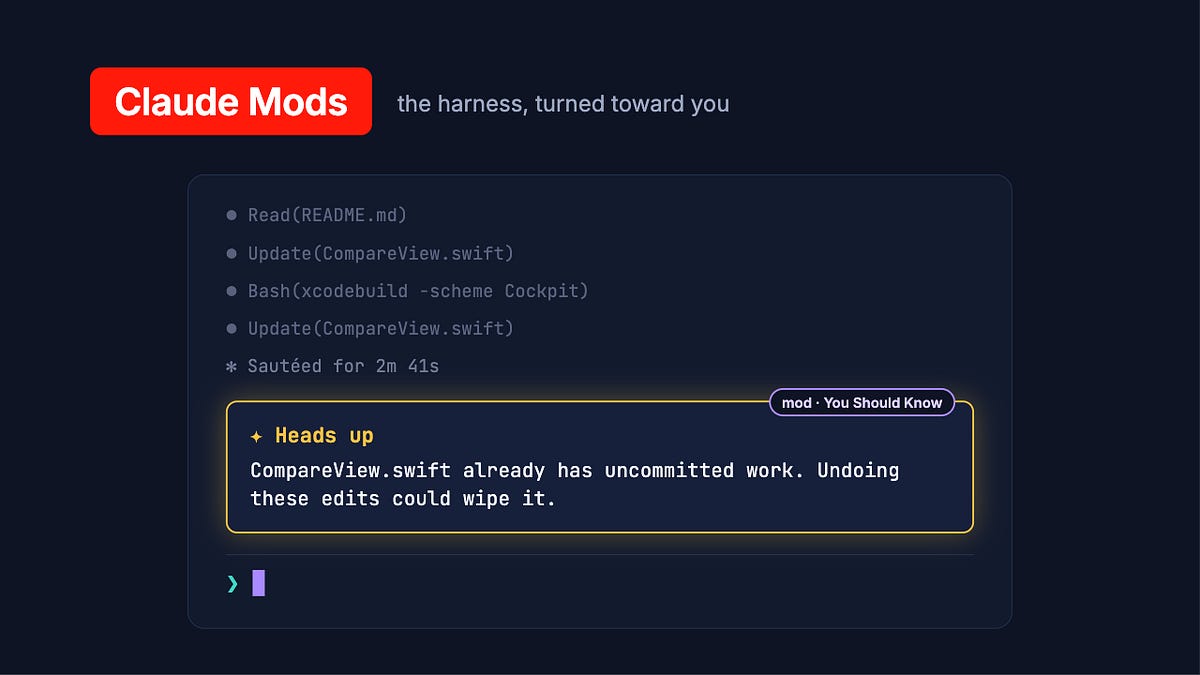
Claude Mods let users alter Claude Code’s prompts, tool-call displays and follow-up actions through JavaScript or TypeScript plugins. The author argues that agent harnesses are becoming attention interfaces: systems that decide what humans notice and when they must intervene. Examples include warnings about uncommitted work and supervisors that recommend next steps, while comparisons with ChatGPT’s generated interfaces and Cursor’s review routing show different control models. The analysis also documents substantial noise, token costs and permission risks, making usefulness dependent on careful customization.
Editorial summary · Publisher article
What matters
- Claude Mods can observe and modify agent events, making the human-facing layer programmable.
- The author reports that a supervisor was useful for catching hidden uncommitted work but often produced noisy alerts.
- Mods run with broad permissions and are not sandboxed, so users must assess their code and usage costs.
Three models of attention control
The analysis contrasts model-designed interfaces in ChatGPT, policy-driven review routing in Cursor and user-programmed interfaces in Claude Mods. Their main distinction is who controls the interaction layer.
The practical tradeoff
The author’s proposed test is whether a mod surfaces something likely to be missed, simplifies a decision or enables action without distraction. Otherwise, added interface output becomes window-dressing.
Context & caveats
- The article is an individual practitioner’s analysis and examples, not an independent evaluation of Claude Mods across users or workflows.
Why this made the edition
Detailed practitioner analysis explains how programmable agent interfaces work, compares three approaches and documents concrete benefits, costs, noise and security risks.
Source material