Technology
Uber’s Genie combines retrieval, human escalation and evaluation for engineering support
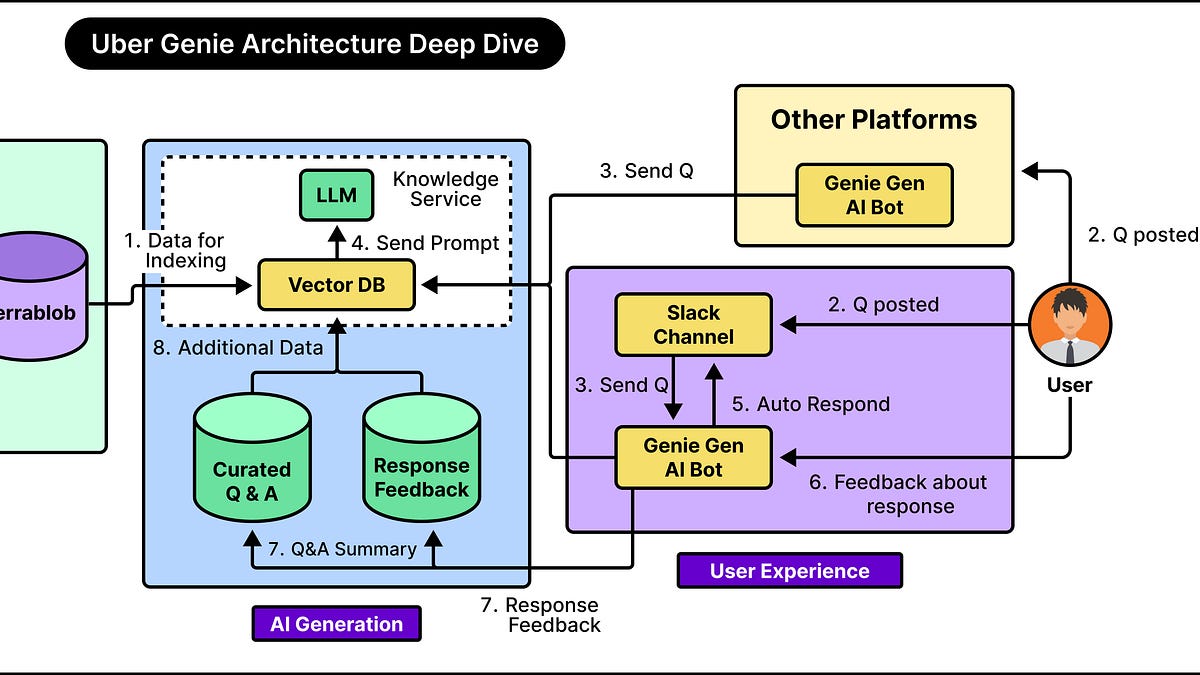
Uber’s Genie answers engineering support questions in Slack by retrieving passages from internal documentation and asking a language model to explain them with source links. The system separates document preparation, vector search and response generation, while offering follow-up questions or escalation to human support when information is insufficient. Uber also evaluates both answers and source documents, using feedback and model-based judging. The article reports 154 channels, more than 70,000 answered questions and a 48.9% helpfulness rate, but says its account is reconstructed from public details.
Editorial summary · Publisher article
Retrieval is only one part of reliability
Genie prepares documents through an ETL pipeline, chunks them, generates embeddings and serves searches through Uber’s internal vector infrastructure. The model receives retrieved passages with source information, but accurate retrieval cannot guarantee a correct answer if the document or generation is flawed.
Human handoff and measurement close the loop
Users can mark answers resolved, helpful, not helpful or not relevant, and can hand interactions to on-call engineers. Uber separately evaluates answer quality and document quality, allowing improvements to retrieval material as well as generated responses.
Context & caveats
- The article is an explanatory reconstruction based on publicly shared details and includes a disclaimer that some details may be inaccurate.
- The reported helpfulness and time savings are Uber’s figures, not independently audited results.
Why this made the edition
The article gives a detailed, technically coherent account of Uber’s internal documentation assistant, covering retrieval, serving, escalation, feedback, evaluation and reported outcomes while acknowledging that it is based on publicly shared details.
Source material