Reading room
Financial firms are designing agent autonomy around controls, auditability and human judgment
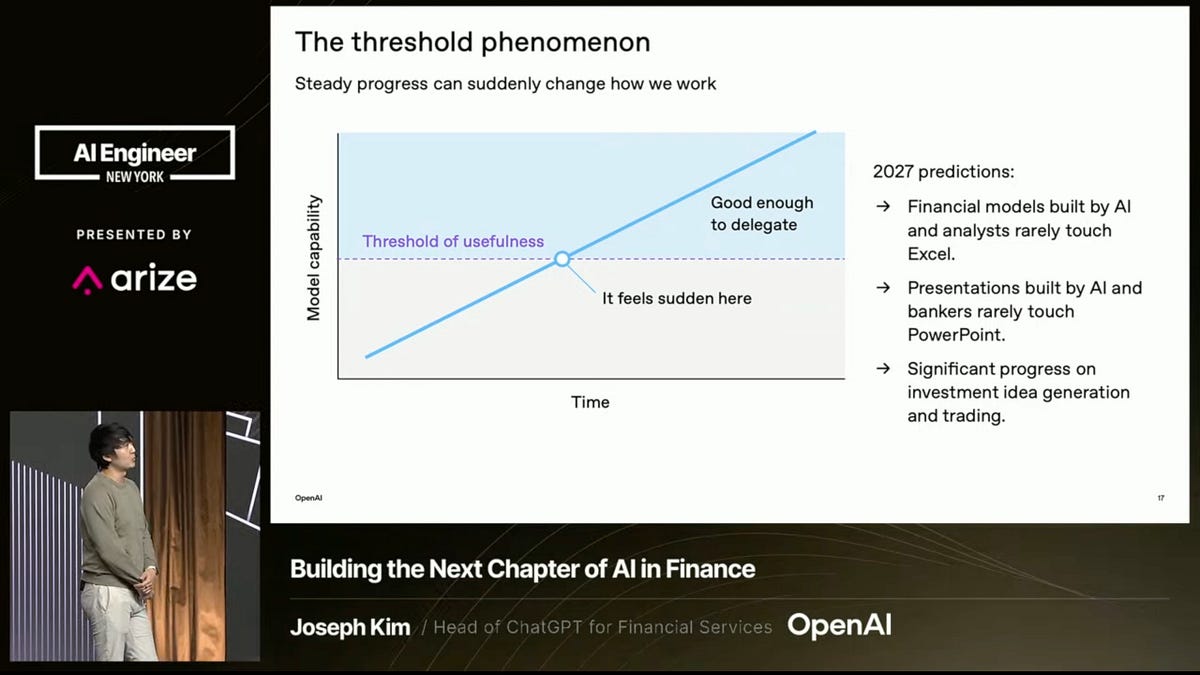
Presentations from OpenAI, Two Sigma, Anthropic and Bloomberg converge on a practical view of financial-agent safety: autonomy should be bounded by identity, permissions, tool controls, audit trails and carefully chosen human approvals. Speakers argued that requiring approval for every action can create fatigue and risk, while deterministic safeguards outside the model can support faster work. OpenAI’s forecasts about agents generating investment ideas or trading in 2027 remain predictions, not demonstrated results.
Editorial summary · Publisher article
What matters
- Two Sigma uses composable controls and classifiers to route routine or ambiguous decisions appropriately.
- Anthropic’s framework separates who an agent represents, what it may do and when a person must approve an action.
- Bloomberg emphasized scoped credentials, outbound restrictions, budgets, logging and kill switches outside the model.
The threshold of usefulness
OpenAI’s Joseph Kim described a threshold at which models become reliable enough to save analysts time and predicted a larger role for agents in financial work. He also emphasized traceability so users can inspect where numbers came from and understand their context.
Avoiding approval fatigue
Two Sigma’s John Feminella argued that safety and innovation are not opposites. His approach uses composable controls and auto-mode classifiers to reserve human attention for decisions where it can materially change the outcome, rather than forcing approval of every routine call.
Separate proposing from acting
Anthropic’s example of a trade-break investigation agent illustrates a deliberate boundary: the system can recommend an order amendment, but a person approves it before the underlying data changes. Identity and permissions form part of the trust layer.
Security must extend beyond the model
Bloomberg’s examples included agents following instructions hidden in marketplace reviews. The proposed defenses—input validation, provenance tracking, tool-call controls, audit trails, spending limits and kill switches—treat the surrounding system as part of the security boundary.
The implementation burden
The analysis concludes that financial firms, rather than frontier labs alone, must decide where controls belong and how much autonomy is appropriate. The central design goal is to let agents move quickly while preserving a reliable way to stop them safely.
Context & caveats
- The 2027 forecasts are speaker predictions, and the supplied account does not provide independent performance evidence for the proposed agent systems.
Why this made the edition
The analysis draws on named presentations from OpenAI, Two Sigma, Anthropic and Bloomberg, giving the reader concrete frameworks for deploying autonomous financial agents. Predictions are attributed, while operational controls and examples provide substantive context.
Source material