Listening room
Dyna Robotics argues that reliable physical AI requires models, hardware and deployment
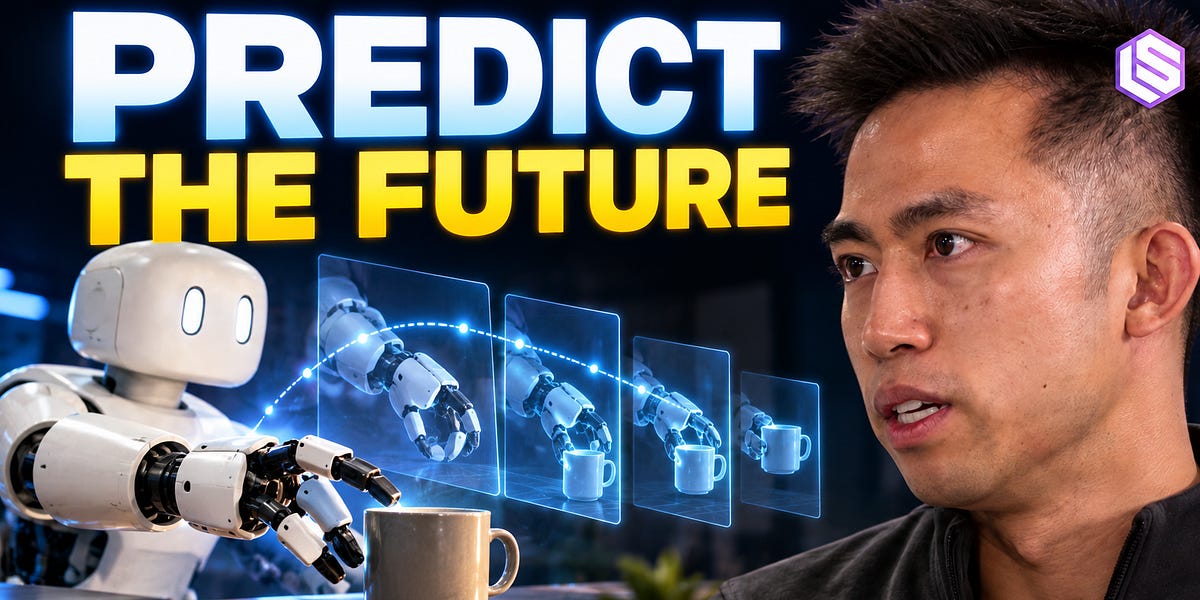
Jason Ma, Dyna Robotics’ co-founder and chief scientist, explains the company’s world-action model, which predicts future visual states alongside robot actions. He argues that general-purpose robotics depends on combining broad human video with smaller amounts of robot data, then adapting quickly to specific tasks. The interview also details Dyna’s wheeled semi-humanoid hardware, on-device inference, agentic control for hour-long workflows and deployments folding napkins at Din Tai Fung. Reported success rates, customer scale and future targets are company claims presented in the conversation.
Editorial summary · Publisher transcript
The takeaways
- Dyna’s world-action model combines video, robot-state inputs and language instructions to predict future states and generate physical actions.
- The company says human egocentric video provides broad physical priors, while robot demonstrations close the gap between human behavior and specific hardware.
- Dyna favors wheeled semi-humanoids for present deployments, citing lower energy use, greater stability and easier safety management than legged robots.
- The company says robots fold thousands of napkins daily across multiple Din Tai Fung locations, which it distinguishes from one-site pilots.
- Fast local inference is treated as essential for reactive tasks; Dyna trains larger models and expects to distill them for deployment.
- Longer workflows require an agentic harness that handles sequencing and high-level decisions around a lower-level action model.
A world-action model for physical control
Ma describes Dyna-2 as a model that predicts how the world will evolve and uses those predictions to guide robot actions. Inputs include recent camera observations, joint encoders and language instructions; outputs include actions and future visual states. He presents this as a way to reason about physical consequences before acting, while acknowledging that the approach remains one company’s design choice rather than an industry standard.
Data is the central scaling problem
Dyna says its model was pretrained on more than one million hours of human video, especially egocentric footage. Ma argues that human data offers diverse knowledge about physical activity but cannot directly determine robot actions when bodies and sensors differ. Robot demonstrations are more expensive but provide the task-specific adaptation needed for dexterity and reliable execution. He expects both custom data collection and synthetic environments to become important.
Synthetic environments and self-generated data
Ma says newer frontier models make synthetic robotics data more promising because they can assist with visual reconstruction, CAD-like environment creation and 3D understanding. Dyna is also exploring whether its own world model can generate training videos, creating a feedback loop between model predictions and additional data. These are described as active directions and potential accelerators, not demonstrated replacements for real-world data.
Hardware is part of the intelligence stack
Dyna builds much of its own platform while buying mature components such as lidar. Ma links custom actuators and human-like proportions to better simulation, control and transfer from human data. The company chose wheels beneath a humanoid-style upper body to improve stability, energy efficiency and safety during current deployments. He also emphasizes that global supply chains, rare materials and manufacturing remain underappreciated constraints.
Fast adaptation meets difficult evaluation
The company says some new tasks can be learned from tens of minutes to a few hours of teleoperated demonstrations, followed by deployment and iterative data collection. Ma compares this loop with a robotics version of human feedback: real-world rollouts reveal failure modes, which become additional training examples. The transcript does not provide independent benchmarks for the reported adaptation times or success rates.
Where longer autonomy breaks down
Dyna says its laundry workflow can already run for about an hour, but broader workflows expose hardware and sensing limits. Dexterous hands reportedly overheat, while current data often omits touch, sound and other signals humans use during manipulation. Ma argues that scaling visual data alone may not solve tasks whose key information is tactile or multimodal.
From individual skills to physical agents
Ma describes an agentic harness around the action model that can manage recipes, wait for machines, switch tasks and coordinate multiple capabilities. The goal is unsupervised workflows lasting hours rather than isolated thirty-second demonstrations. He compares this architecture with the shift from autocomplete to end-to-end coding agents, while stressing that physical autonomy also depends on hardware, sensing and reliable low-level control.
Deployment as the company’s research loop
Dyna frames customer deployment as a source of technical feedback, not merely a commercial milestone. The company says it has deployed tens of robots in laundry and restaurant settings and aims for hundreds in the following year. Din Tai Fung is presented as its largest scaled customer, with napkin folding across multiple U.S. locations and possible expansion into food preparation. These milestones and the claimed human-parity performance are statements by Ma in the interview.
The competing theories remain unresolved
Dyna favors human-data pretraining, custom hardware and world-action models, while Ma notes that other groups are scaling robot data, intermediate collection devices, video world models or vision-language-action models. He identifies a possible failure mode for Dyna’s own approach: vision may lack information carried by touch or sound. The interview ends with a deployment-first philosophy and a long-term ambition of thousands of customers and millions of robots.
Context & caveats
- The episode is an interview with Dyna Robotics’ co-founder, so performance, customer scale, success rates and deployment claims are company-reported rather than independently verified.
- The source is a machine transcript with occasional uncertain words, names and numbers; readers should consult the original audio or video for exact wording and demonstrations.
Why this made the edition
A complete publisher transcript provides substantial technical, operational and strategic detail, including the model architecture, data constraints, hardware choices, customer deployments and unresolved bottlenecks. The episode is strongly relevant to AI and robotics readers, though many performance and deployment claims come from Dyna's co-founder and are not independently verified.
Source material