AI
Microsoft details Maia 300’s system design for large-scale AI inference
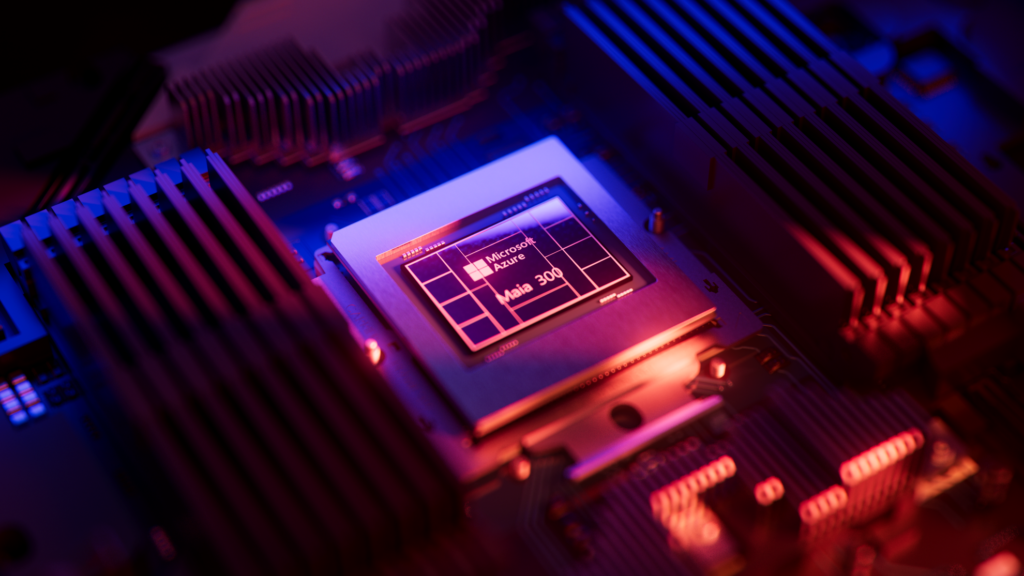
Microsoft says its Maia 300 accelerator system is designed for long-context and agentic inference, combining chiplets, local memory, low-precision formats, custom networking and liquid-cooled racks. The announced configuration places 96 accelerators in a 167-kilowatt rack and links up to 12,288 accelerators in a superpod. Microsoft claims up to seven times the rack-scale token throughput and more than 2.5 times the performance per watt of Maia 200. Those comparisons are first-party claims without independent benchmark results here.
Editorial summary · Publisher article
What matters
- The system uses locality-aware memory across chiplets, eight HBM4 stacks and software-controlled data movement.
- A rack contains 96 accelerators, while the scale-up fabric can connect up to 12,288 accelerators across 128 racks.
- Microsoft supports separate prefill and decode placement and direct movement of KV state over the scale-up fabric.
- The rack combines liquid cooling, power telemetry and workload placement controls to operate within datacenter power and cooling limits.
Why the design matters
The architecture treats inference efficiency as a system problem involving data movement, memory bandwidth, networking, cooling and workload placement, rather than accelerator compute alone. That is especially relevant for decode-heavy and long-context workloads.
Context & caveats
- All performance, efficiency and deployment claims come from Microsoft’s announcement and are not independently validated in the supplied packet.
- The announcement describes intended capabilities and does not establish commercial availability or customer adoption.
Why this made the edition
Microsoft provides substantial architectural detail on Maia 300, including memory, networking, rack density, cooling and deployment design. The performance and efficiency results are Microsoft’s own claims, and the packet lacks independent benchmarks, but the announcement is relevant to AI infrastructure and cloud-scale inference economics.
Source material