AI
Why energy-based models may complement language models on precisely verifiable tasks
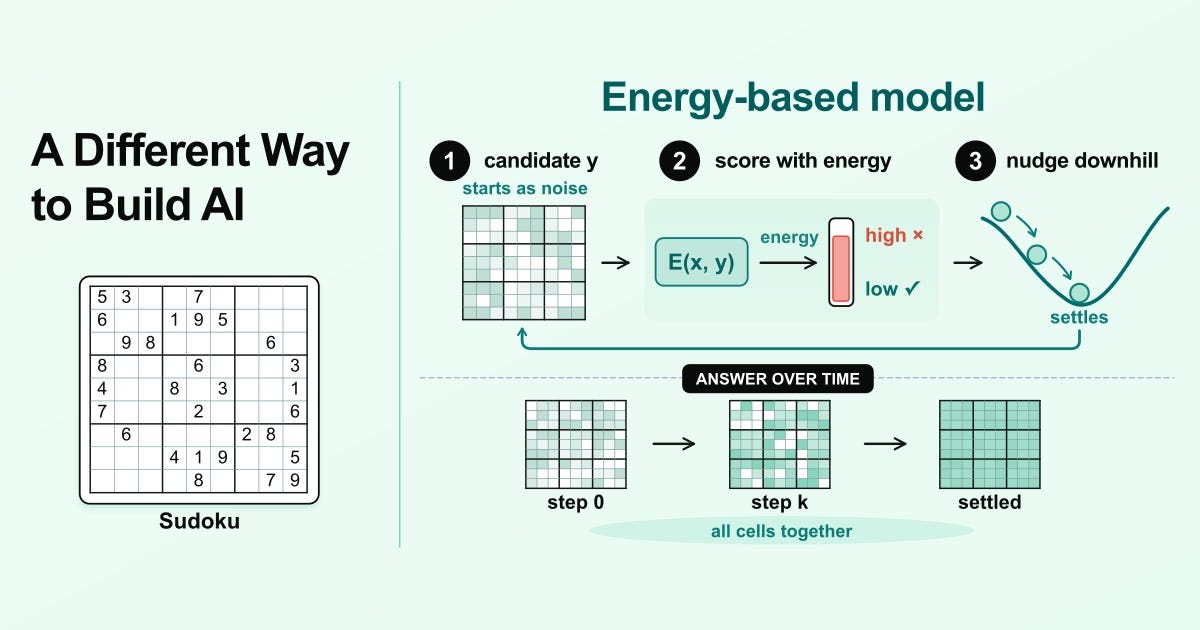
An interview-led analysis argues that language models struggle with constraint problems because they generate discrete outputs sequentially, while energy-based reasoning models search continuously for lower-energy solutions. The approach appears well suited to tasks such as Sudoku, formal mathematics and chip design where correctness can be checked mechanically. The article also describes a hybrid division of labor in which language models handle language and energy-based systems handle constraints. Most performance and industry forecasts come from Logical Intelligence and remain early-stage claims.
Editorial summary · Publisher article
What matters
- Energy-based models score candidate answers and use gradient descent to search for solutions rather than generating tokens left to right.
- Logical Intelligence reports that its small Kona model solved Sudoku much faster and more cheaply than tested frontier language models, though the article does not independently validate the experiment.
- Machine verification can reject an invalid result, but it cannot ensure that the formalized constraints capture the user’s real intent.
- The proposed architecture assigns language models interface and judgment tasks while specialized models handle objective, checkable problems.
Where the approach fits
The strongest case is for problems with explicit rules and machine-checkable answers. Open-ended writing and recommendations remain better suited to language models because their quality is difficult to define precisely.
Limits and industry implications
The author presents the field as young and reports Logical Intelligence’s expectation of specialized models, different hardware and customer-specific deployments. Those forecasts are company and interview claims, not established industry outcomes.
Context & caveats
- The article is based substantially on an interview with Logical Intelligence’s founder, and several benchmark and cost figures are reported rather than independently verified.
- Formal verification confirms stated constraints, not whether those constraints fully represent the user’s intent.
Why this made the edition
A detailed, technically substantive analysis of energy-based reasoning models, with clear explanations of training, inference, verification, costs and limitations. Its performance claims are attributed to Logical Intelligence rather than presented as independently established results.
Source material