Listening room
AlphaFold was a beginning, not the end, of AI-driven biology
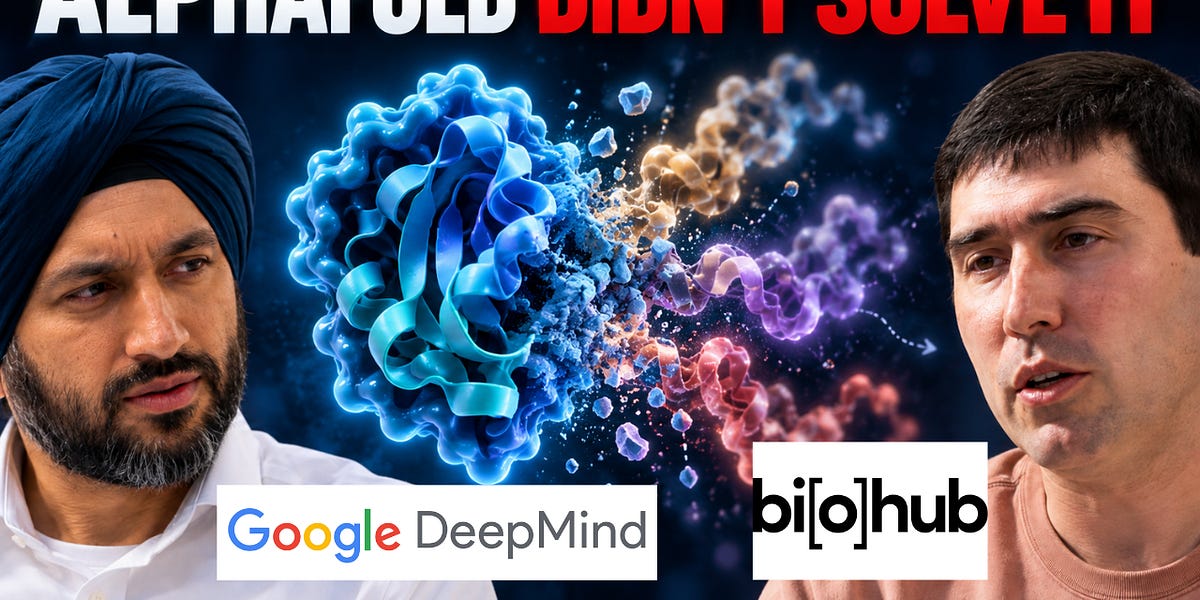
Google DeepMind’s Pushmeet Kohli and Biohub’s Sal Candido argue that biological AI will advance through problem-specific combinations of modeling, data generation and scientific expertise. They say AlphaFold reproduced deposited structures but did not solve protein dynamics, function or whole-cell biology. The panel emphasizes calibrated uncertainty over perfect interpretability, richer data such as cryo-EM imagery, and models that move from individual proteins to biological systems. Their predictions about dramatic drug-discovery acceleration remain forward-looking.
Editorial summary · Publisher transcript
The takeaways
- Finding a useful scaling law is itself a scientific challenge; more compute or data helps only when it contains relevant information.
- Metagenomic sequences can improve protein-language models despite being noisy, but availability should not dictate the research agenda.
- Scientific inductive bias can improve data efficiency, while incorrect assumptions may become constraints at larger scales.
- AlphaFold’s structural predictions do not capture the full dynamics, disorder or contextual behavior of proteins.
- Trustworthy deployment depends on understanding model behavior and calibrating uncertainty, not necessarily making every internal mechanism human-interpretable.
- The guests expect continued AI use in drug discovery, but major acceleration requires better biological models; their timelines are opinions, not established forecasts.
The problem should determine the method
Candido and Kohli reject a fixed allegiance to either modeling or data generation. They argue that teams should define the scientific problem, assess constraints, and then decide whether progress requires better models, more compute, new data or domain expertise.
Data quality and coverage
Noisy metagenomic data can reveal useful patterns, but simply scaling convenient datasets risks optimizing for availability rather than scientific impact. The panel favors coordinated, open work to identify missing information.
Craft and scale
AlphaFold benefited from biophysical insight encoded into its architecture. The guests also describe scaling as an area requiring algorithmic craft, with architectures evolving beyond standard Transformers without abandoning them.
What AlphaFold left unsolved
The model reproduced experimentally deposited structures; it did not establish the full distribution of protein conformations or explain how proteins change with context. Protein function, dynamics and design remain open problems.
Toward richer biological models
Kohli points to cryo-EM micrographs as a potentially richer source of structural and dynamic information. Candido argues that useful models must expand from individual proteins to interacting biological systems.
Trust, interpretation and impact
The discussion distinguishes human-readable explanations from behavioral reliability. Calibrated confidence and known limitations may matter more for decisions than complete internal interpretability, while major clinical acceleration remains a hypothesis.
Context & caveats
- The speakers’ expectations of rapid or 10x–100x biomedical acceleration are forecasts, not independently established results.
- The transcript identifies the event as a publisher transcript; no machine-transcription uncertainty is reported.
Why this made the edition
Complete publisher transcript with substantive discussion from both guests, covering data strategy, model design, AlphaFold’s limits, interpretability and biomedical impact. The episode is relevant to AI and scientific computing, though its forecasts remain expert judgments rather than demonstrated outcomes.
Source material