Reading room
Reliable LLM applications need output validation as well as retries
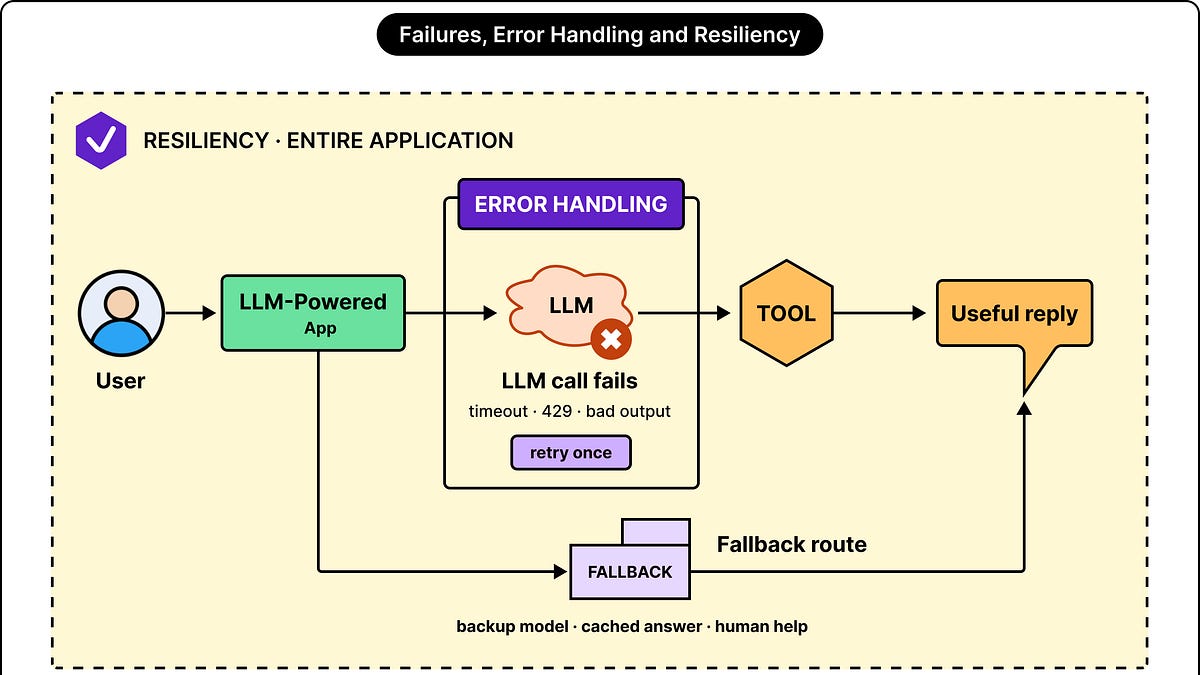
ByteByteGo's engineering guide argues that LLM applications must handle both failed requests and successful requests that return unusable or incorrect answers. It connects failure categories to bounded retries, schema validation, fallbacks, circuit breakers and workload controls. A payment example shows why repeating an operation after a lost response can duplicate a charge. The practical implication is to design recovery across the entire workflow, while recognizing that valid formatting alone cannot establish factual correctness.
Editorial summary · Publisher article
What matters
- Use bounded retries with exponential backoff and jitter for suitable transient failures; unchanged credentials or bad input require correction.
- Validate structured responses and check substantive claims against trusted data or human review.
- Preserve operation state and use idempotency to avoid repeating successful side effects after communication failures.
- Choose fallbacks that preserve task requirements and avoid sharing the primary path's failure points.
Control demand during failures
Circuit breakers pause calls to unhealthy services and probe for recovery. Queues, concurrency limits and workflow budgets help prevent excess demand from exhausting provider capacity or application resources, with interactive work prioritized over background jobs.
Why this made the edition
A substantial engineering explainer connects failure classification to concrete recovery mechanisms and transaction risks. The sponsored introduction is separable from the useful technical material.
Source material